This article outlines the standard 12-week enterprise onboarding process for new OPSCOM clients. It provides an overview of the project phases, from initial discovery through to the final live launch, ensuring administrators understand their responsibilities during the rollout.
### Project Phases Overview The onboarding journey is structured into five distinct phases designed to ensure a smooth and successful system deployment. #### Phase 1: Learning the Basics (Estimated: 2 Weeks) Following the receipt of your signed contract, an OPSCOM representative will initiate the project with a discovery call. This meeting is crucial for aligning expectations and defining project scope. - Participate in a project kick-off meeting via Google Meet. - Identify and invite relevant team members to discovery sessions. - Review the roles and responsibilities of the OPSCOM team and your organization. - Receive your system site setup and login credentials via email.Billing commences immediately upon site creation. All clients are provided with net 30 payment terms.
#### Phase 2: Standard Component Assembly (Estimated: 2 Weeks) This phase focuses on the technical and financial foundation of your installation. Your **Account Executive** and **Trainer** will guide you through these core configurations: - Configure **Admin** and **Client Domains**. - Determine access requirements for the system. - Establish your **Roles and Permissions**. - Create **Administrator Accounts**. #### Phase 3: Tailored Configuration (Estimated: 3-4 Weeks) In this phase, the focus shifts to tailoring the system to your specific operational needs, including any custom development or data imports. - Configure **Admin Options**, **Lots**, **Permit Options**, and **Violation Options**. - Set up **System Messaging** and **User Portal** templates. - Customize **Email Templates**. - Place orders for necessary **Violation** stock.During this phase, you will be introduced to the self-guided training agenda. Use this opportunity to explore your **Preview System** to gain familiarity with the platform's functionality.
#### Phase 4: Final Testing (Estimated: 2-3 Weeks) This is the final testing phase designed to identify any operational needs or system bugs before the public launch. - Collaborate with your **Training** representative to ensure full system comprehension. - Attend scheduled live training sessions to walk through key system modules. - Conduct comprehensive testing of all installation functionalities. #### Phase 5: Go Live (Estimated: 1 Day) Once all requirements are met and testing is complete, the final launch occurs. - Complete all remaining custom requirements. - Verify system readiness with your project team. - Launch your live site for public use. This is what a 12 Week Enterprise Onboarding schedule looks like. [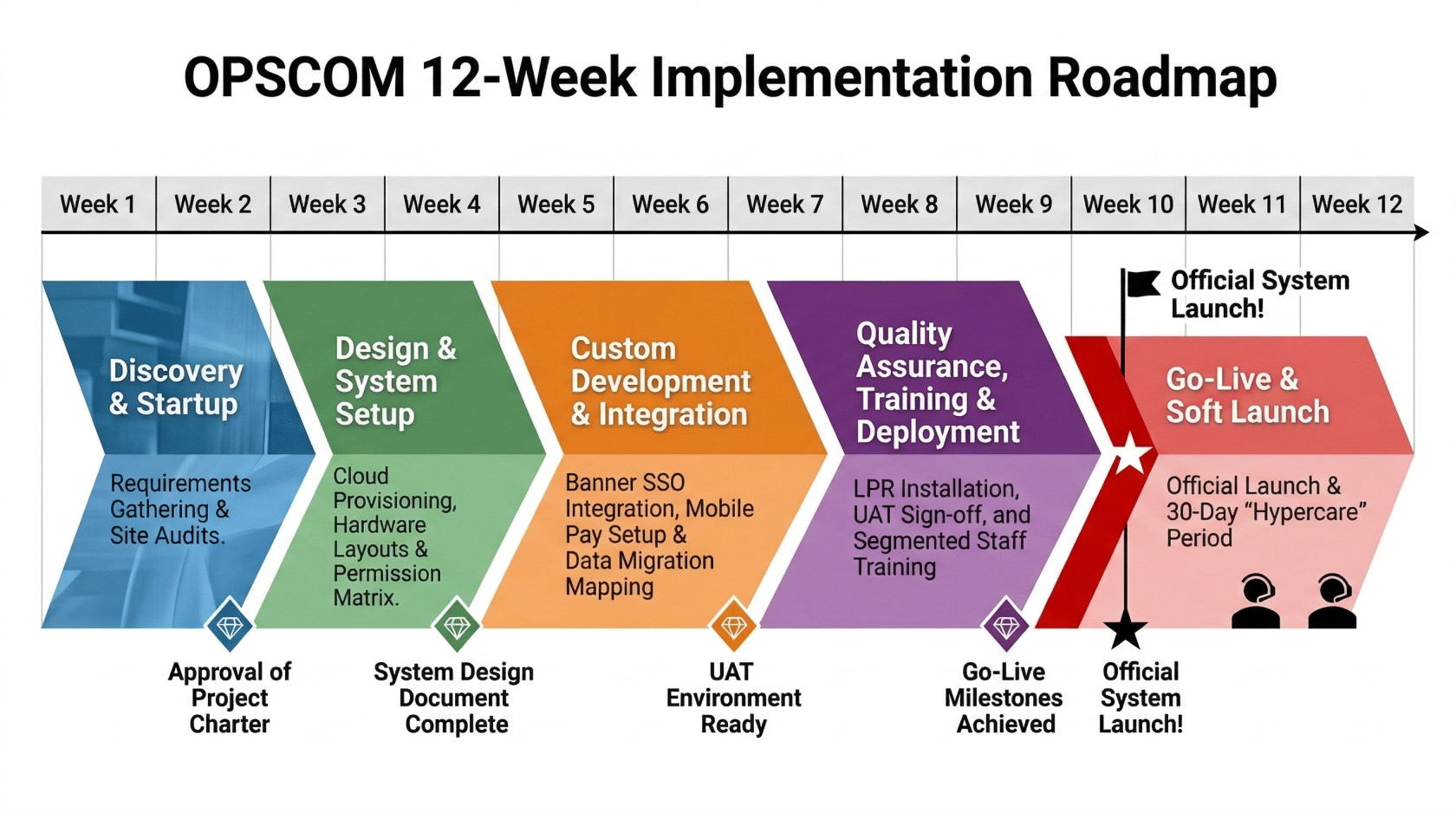](https://opscom.wiki/uploads/images/gallery/2026-03/12-week-deployment-rfp.png) --- ### Best Practices and Considerations - **Team Involvement**: Ensure the appropriate stakeholders from your organization are involved early in the discovery phase to clarify business processes and expectations. - **Production vs. Preview**: While you should use your **Preview System** to test and learn, ensure all final configurations are applied directly to your **Production** environment. - **Active Participation**: The onboarding process is a collaborative effort. **Maximize the value of your training sessions by preparing specific questions about your organization's unique operational workflows.** # Starting your Enterprise OnboardingThis article outlines the initial administrative requirements and collaborative team structure for new enterprise deployments. Its primary purpose is to help OPSCOM administrators and project leads understand their responsibilities to ensure a seamless system setup and launch.
## Setup and Configuration A successful deployment relies on a collaborative approach between your organization and the OPSCOM team. To ensure the system aligns with your specific operational processes, clear roles and billing details must be established immediately. ### Client Responsibilities Every client must designate an internal project manager, often the Parking Manager, who understands the business goals and can dedicate time to the project. Assemble your internal team by completing the following: - Designate an internal project manager to oversee the project and assemble the deployment team. - Assign an IT contact to manage Single Sign-On (SSO) and system integrations. - Assign a hardware contact to manage handheld devices, printers, and cameras. - Assign a financial contact to manage hosted payment details and billing information.If your organization is unable to provide a dedicated internal project manager, one can be provided by the OPSCOM team for an additional fee.
### OPSCOM Team Responsibilities Our team will match your resources with dedicated specialists: - **Overall Project Manager:** Manages the technical deployment, coordinates training, assists with system setup, and ensures all custom requirements are met. - **Setup and Configuration Specialist:** Advises on system best practices, shares solutions from other clients, and assists in mapping your current business processes to the system. - **Trainer and Support Liaison:** Provides system training and introduces you to post-launch support processes. ## Using this Feature Throughout the onboarding process, administrators will interact directly with our support and security resources. ### Customer Account and Billing Once your contract is signed, you are initialized in our billing system and will receive a welcome email with account details. Finalize your account setup by sending the following details to the OPSCOM team: - Provide a name, email address, and telephone number for your accounts payable contact. - Provide a name, address, email address, and telephone number for your main project contact. - Provide the names and email addresses for your IT, hardware, and financial contacts. - Provide a purchase order number if applicable to your organization. ### Communicating Security Information We prioritize data safety and system security. - Share the OperationsCommander Security White Paper with your IT department if they require documentation regarding our security protocols. - EmailWelcome to OperationsCommander! We are delighted to have you on board as you begin your journey toward seamless parking management. We believe in making every step a delight, and these first steps are designed to be intuitive and efficient. Please click on any of the titles below to discover more information and proceed with your setup.
### Admin and Client Domains Your OperationsCommander platform consists of two distinct portals: - **Admin Portal**: Accessed via `yourdomain.OPSCOM.com/admin`. This is where administrators manage system operations. - **User Portal**: Accessed via `yourdomain.OPSCOM.com/u`. This client-facing site should be shared with your end-users.You can customize the **User Portal** by adding your organization’s logo and colors to ensure it aligns with your brand. Reference this URL in all client-facing communications.
### First Time Login and Orientation Upon your initial login using the credentials provided by the OPSCOM team, you will be greeted by the **Admin Dashboard**. - **Secure Access**: The initial account provided is configured for the highest level of access and should be reserved for high-level administrators only. - **Setup Checklist**: Use the built-in **Setup Checklist** on your **Admin Dashboard** to ensure all essential settings are configured correctly before moving to the next implementation phase. - **Training Materials**: Access the [Learn Dash Training Materials](https://learn.ops-com.com/) directly from your dashboard to begin your onboarding journey ### System Environments OperationsCommander provides two separate environments to ensure system stability and operational integrity: - **Production Site**: Your live environment used for actual daily operations. - **Preview Spaces**: A secure, isolated testing environment that mirrors your **Production** data. Use these spaces as a sandbox to test new features, stage configuration changes, or conduct staff training without impacting your live operations. Learn more about [Preview Spaces and Production Sites](https://opscom.wiki/books/setup-configuration-for-admins/page/create-or-refresh-a-preview-space) here. ### Access and Security Configuration Administrators can tailor system access to fit unique organizational needs. - **[Roles and Permissions](https://opscom.wiki/books/setup-configuration-for-admins/page/manage-roles-and-permissions)**: Use **Roles** to group specific permissions and restrict access to information or features. Admins can be assigned multiple roles to provide the exact level of access required for their job function (e.g., a **Patrol Officer** role). - **[Creating Administrator Accounts](https://opscom.wiki/books/setup-configuration-for-admins/page/manage-admin-user-accounts)**: Upon setup, one master administrator account is provided. To add additional administrators, follow the steps outlined in the *Creating Administrator Accounts* wiki article. - **[Admin Dashboard Customization](https://opscom.wiki/books/the-opscom-admin-portal/chapter/landing-page-and-dashboards)**: You can edit the landing page of the **Admin Portal** to display critical information for your team, such as **Pricing Information**, **Contact Information**, **Scheduling Information**, **Organizational Information**, or **Legal Notices**. --- ### Best Practices and Considerations - **Training**: Utilize the [OPSCOM Wiki and Training](https://opscom.wiki/books) modules to transition your staff to the new system at their own pace. - **Security**: Ensure the master account provided during setup is limited to authorized high-level personnel to maintain system security. - **Testing**: **Always perform functional testing and staff training within your Preview Spaces before applying changes to your Production site.** # Setup ChecklistThe **Setup Checklist** is a central tool designed to guide new OPSCOM administrators through the critical process of configuring a new site. This article helps administrators prioritize essential configuration tasks and system messaging updates required for a successful launch.
### Understanding the Setup Checklist The **Setup Checklist** categorizes necessary tasks by priority to help you focus your efforts efficiently. - **Important**: Critical configurations that must be completed for system functionality. - **Moderate**: Recommended configurations to optimize your system setup. - **Minor**: Optional adjustments to further refine your site's design and user messaging. The checklist can be expanded to display all configuration and page update tasks that a new user should consider during the onboarding process. 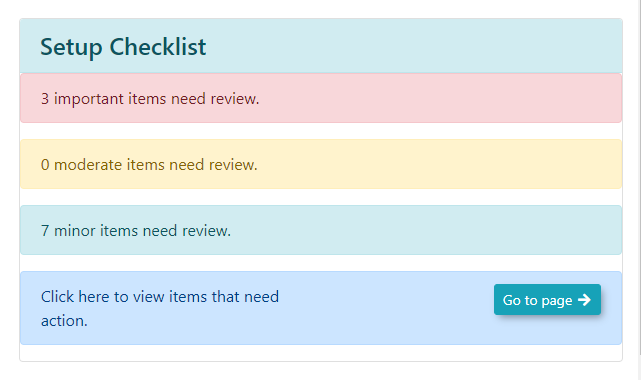 ### Using this Feature Administrators can use the checklist to navigate directly to the areas requiring attention, streamlining the setup workflow. 1\. Click on any section within the **Setup Checklist** to expand the list and view specific tasks. 2\. Click the **Edit** button associated with a task to be brought directly to the relevant configuration or page update screen.The **Edit** button functionality applies to both general system configurations and **System Messaging** updates, ensuring you can quickly access the page that requires your input.
--- ### Best Practices and Considerations - **Prioritize Tasks**: **Focus on completing items labeled as Important first** to ensure your production system is functional before moving on to moderate or minor refinements. - **System Messaging**: Use the **Edit** button within the messaging sections to ensure your portal communications, disclaimers, and email templates are tailored to your organization’s needs. - **Regular Review**: As you progress through your onboarding, revisit the **Setup Checklist** to track your completion status and identify any remaining configuration gaps. # Phase 2 - Payment Provider SetupThis article outlines how OPSCOM administrators can implement **Hosted Payments** to securely manage financial transactions within the OperationsCommander system. It is intended for administrators responsible for configuring payment processing and managing organizational payment policies.
### Setup and Configuration **[Hosted Payments](https://opscom.wiki/books/the-opscom-admin-portal/page/hosted-payments)** allow a third-party payment processor to handle sensitive credit card information directly, providing an essential layer of security by ensuring that payment data is never stored within the OperationsCommander environment. 1. Contact your **Account Executive** to initiate the setup process with one of our integrated hosted payment providers. 2. Once your provider account is established, navigate to the specific configuration steps for your chosen provider. 3. Consult the [Managing Payment Types](https://opscom.wiki/books/setup-configuration-for-admins/page/managing-payment-types) wiki article to complete the configuration for your specific payment method. #### Integrated Payment Providers OPSCOM seamlessly integrates with the following hosted solutions: - **[Bambora Checkout](https://opscom.wiki/books/the-opscom-admin-portal/page/bambora-checkout)** - **[EdgeExpress](https://opscom.wiki/books/the-opscom-admin-portal/page/openedge-hosted-payments)** - **[Moneris Checkout](https://opscom.wiki/books/the-opscom-admin-portal/page/moneris-checkout)** ### Using this Feature Administrators have comprehensive control over how payments are processed and who can access specific payment methods. #### Managing Payment Types The **Managing Payment Types** section allows you to customize available payment methods based on your organization's financial policies. - Define new payment options. - Assign specific payment methods to **User Types** (e.g., **Staff**, **Students**, or the **Public**). - Configure payment methods for recurring subscriptions or guest checkout scenarios. #### Guest Payments **[Guest Payments](https://opscom.wiki/books/the-opscom-admin-portal/page/setting-up-quick-payguest-payments)** (QuickPay) provide a streamlined experience for users, allowing them to look up, appeal, or pay citations without requiring an account login. This reduces administrative overhead and increases user satisfaction.To finalize your payment configuration, you will need to proceed with the tasks outlined in *Phase 3 Config & Admin Options*.
--- ### Best Practices and Considerations - **Security**: Always utilize **Hosted Payments** whenever possible to minimize your organization’s exposure to sensitive credit card data. - **Consistency**: **Ensure your payment types are correctly mapped to the appropriate User Types to maintain accurate financial reporting.** - **Planning**: Coordinate with your **Account Executive** early in the deployment process to ensure your chosen payment provider is configured to meet your organization's specific billing cycle and policy requirements. # Phase 3 - Configuration and Admin OptionsThis article provides OPSCOM administrators with a roadmap for Phase 3 of the system implementation. During this phase, you will configure core operational settings, customize user-facing portals, and prepare your enforcement modules for deployment.
### [Setup and Configuration](https://opscom.wiki/books/setup-configuration-for-admins) Phase 3 focuses on tailoring the system to your organization's specific business processes. Administrators should focus on the following key areas: - **[User Types](https://opscom.wiki/books/setup-configuration-for-admins/page/user-types)**: Categorize your users (e.g., **Student**, **Staff**, **Public**) to define distinct parking rules, permissions, and system functionalities. - **[User Profile Settings](https://opscom.wiki/books/setup-configuration-for-admins/page/defining-user-profile-settings)**: Adjust the visibility and requirements of profile fields to collect necessary information from users during registration. - **[Vehicle Configuration](https://opscom.wiki/books/setup-configuration-for-admins/chapter/vehicle-configuration)**: Define the vehicle description parameters your organization needs to track for enforcement and permitting purposes. - **[System Settings Customization](https://opscom.wiki/books/setup-configuration-for-admins/page/guide-to-system-settings)**: Utilize the centralized **System Settings** area to fine-tune core functionalities, including general parameters, security protocols, and module-specific behavior for parking, violations, and payments. - **[User Portal Branding](https://opscom.wiki/books/setup-configuration-for-admins/page/user-portal-branding-and-setup)**: Configure your **Default Site Logo** and **Default Site Header** to ensure your branding remains consistent across all user-facing interfaces. - **[Email Templates](https://opscom.wiki/books/setup-configuration-for-admins/page/email-templates)**: Use the smart editor to customize automated email notifications, ensuring communication with your users is clear and professionally branded. - **[System Messaging](https://opscom.wiki/books/setup-configuration-for-admins/page/pages-and-content-blocks)**: Review and update priority messages and elements across the **User Portal**, including: - **System Messages/Pages**: **Login**, **Permits**, and **User Registration**. - **System Messages/Messages**: **Admin Dashboard**, **The Vehicle Disclaimer**, and **The Permit Disclaimer**. - **Email Headers and Footers**: Customize your **Header** and **Footer** templates. - **Email Templates**: Review **Lost Password** and **User Receipt** templates. ### Module-Specific Setup #### [ViolationAdmin Setup](https://opscom.wiki/books/setup-configuration-for-admins/chapter/violations-configuration) To configure the **ViolationAdmin** module, you must complete the following mandatory tasks: 1. Setup **Ticket Categories**. 2. Setup **Offence Items**. 3. Setup **Locations**. #### Violation Stock Management If your organization uses printed tickets, coordinate with your **Account Executive** to approve the ticket design. - If sourcing your own stock, allow **4–6 weeks** for printing and shipping. - Order your stock early to avoid deployment delays. #### [Handheld Enforcement](https://opscom.wiki/books/setup-configuration-for-admins/page/handhelds-devices-settings-handheld-commons) Review the **[Handheld Training](https://opscom.wiki/books/legacy-android-enforcement-app-OPSCOM-parking-enforcement/page/handheld-training)** documentation before meeting with your **Training Coordinator** to ensure you are prepared for practical instruction. #### Data Imports If you are transitioning data from a legacy system, ensure your data is cleaned and formatted correctly. Refer to the [Preparing to Import your Data](https://opscom.wiki/books/new-client-onboarding/page/preparing-to-import-your-user-data) wiki article for detailed requirements. --- ### Best Practices and Considerations - **System Integrity**: Before proceeding to live payments, run a **Penny Test** to verify that your transaction flow and payment processing are functioning correctly. - **Standardization**: **Ensure all System Messaging and Email Templates are thoroughly reviewed for tone and accuracy before your go-live date.** - **Advanced Configuration**: While this article provides a high-level overview, refer to the full *Setup and Configuration* section of the wiki for granular instructions on each module. # Using Your Own Domain - Vanity URLOPSCOM supports the use of vanity URLs, allowing organizations to maintain consistent branding by using their own custom domain for portal access. This article is intended for OPSCOM administrators who wish to configure a custom domain or subdomain for their user and admin portals.
### Setup and Configuration Before beginning, please note that not all service levels include this option and additional fees may apply. Contact your **Sales Representative** at **sales@ops-com.com** for confirmation regarding your account eligibility. #### Domain Requirements You may use any legal and registered domain that your organization owns or controls. - Domains and subdomains cannot contain spaces. - Character strings are case-insensitive. - Subdomains may consist of a combination of A-Z, 0-9, and hyphens. #### DNS Configuration The setup process involves pointing a CNAME record at the OPSCOM server. Refer to the table below for the appropriate DNS entry based on your preferred configuration:| **Option** | **Format** | **DNS Entry** | **Notes** |
| 1 | yourdomain.com | @ CNAME <client>.OPSCOM.com | Points the entire domain to your OPSCOM installation. |
| 2 | subdomain.yourdomain.com | subdomain CNAME <client>.OPSCOM.com. | Points a specific subdomain to your OPSCOM installation. |
This article provides OPS-COM administrators with an organized curriculum for mastering the OperationsCommander platform. The self-guided training modules listed below are designed to help you efficiently navigate administrative tasks, enforcement workflows, and financial management.
## Setup and Configuration Ensure the initial system setup is complete before beginning your training journey. If you require more in-depth guidance beyond this self-guided curriculum, paid training sessions are available. Please email**Hands-on Experience:** Apply the concepts learned in each module directly to your Preview System to reinforce your understanding without affecting live production data.
--- ### Best Practices and Considerations - **Self-Paced Learning**: Progress through these modules at a speed that suits your team's operational needs. - **Hands-on Experience**: **Apply the concepts learned in each module directly to your Preview System to reinforce your understanding without affecting live production data.** - **Support**: Keep **This article serves as a final checklist for OPSCOM administrators prior to the official system launch. Following these steps ensures your production environment is fully configured, tested, and ready for public use.
### Pre-Launch Checklist Before proceeding to go live, perform a comprehensive review of your system settings and user-facing portals. - **User Portal Review**: Conduct a final walkthrough of the **User Portal** to ensure all branding, messaging, and layout elements are presented exactly as intended for your customers. - **Experience Testing**: Create a test user account and log in via the portal to experience the platform from the customer's perspective. - **Payment Verification**: Perform a **Penny Test** to confirm your payment provider integration is active and processing transactions correctly. - **Violation Module Configuration**: Verify that all **Offences** and **Locations** are correctly set up if you intend to issue citations. - **Permit and Locker Sales**: Ensure your **Sales Windows** are properly configured for all permits and lockers you intend to offer. - **Enforcement Readiness**: Confirm that all **Lot Zones** are established if your operations include parking enforcement. --- ### Support and Troubleshooting If you encounter any issues or have concerns while completing these final preparations: 1. Capture a clear screenshot of the specific error or area of concern. 2. Email the screenshot and a description of the issue to **Thoroughly testing your **Sales Windows** and **Penny Test** is critical. **Do not move to a live launch until you have successfully verified that both your payment processing and permit sales workflows are fully operational.**
--- ### Best Practices and Considerations - **System Familiarity**: Ensure your administrative team is comfortable navigating the system and that they have reviewed the *Phase 1 Learning the Basics* training materials prior to launch. - **Data Integrity**: Double-check that any imported data from legacy systems is appearing correctly in your production environment. - **Documentation**: Maintain a list of internal contacts for your **IT**, **Hardware**, and **Financial** departments so you can quickly resolve any issues that may arise immediately following the go-live date. # Preparing to Import Your User DataThis article provides OPSCOM administrators with the requirements and best practices for importing existing user data into the system. Proper data preparation is essential for a successful migration and ensures all user profiles, vehicles, and permits are correctly associated within OperationsCommander.
### Data Preparation Strategy Before initiating an import, ensure your data is clean and your strategy is clearly defined. #### Clean Data Export your data from your legacy system and perform a thorough cleanup: - **Remove duplicate entries**. - **Correct typographical errors**. - **Standardize formatting** (e.g., date formats, capitalization, and phone numbers). #### Data Strategy Define your **User Management** strategy before starting the import process: - **Unique ID**: Select a **Unique ID** (e.g., email address, username, or student/staff number). This ID is mandatory for stacking data and associating future records (like vehicles or permits) to the correct user. Ensure this ID is never duplicated. - **SSO**: If your organization utilizes **Single Sign-On (SSO)**, determine your required login source. - **Mandatory Fields**: Identify which user profile details are required. - **System Configuration**: Ensure the following areas are configured in OperationsCommander before importing: - **User Types** - **Lots** - **Vehicle types, colors, and makes** - **Login sources** - **User profile settings** for mandatory fields ### Data Mapping To ensure successful imports, your CSV file headers must match the system's expected attributes. 1. Review the [Request Object Attributes](https://opscom.wiki/books/api-documentation/page/push-api-user-createupdate#bkmk-360) section in the API documentation to identify the **Possible Names** and **Limits** for every field you intend to import. 2. Ensure your CSV column headers align exactly with these attribute names. 3. Build your CSV file, ensuring that all **Required** fields, such as **unique\_id**, adhere to the specified character limits. 4. Follow the steps in the [Using the Database Importer (Beta)](https://opscom.wiki/books/setup-configuration-for-admins/page/using-the-database-importer-beta) guide to begin the upload process.| Unique ID | String | 50-character alphanumeric including dashes. | unique\_id | **(Required)** An unique identification number of the user. |
Data imports can be complex and may incur additional costs. Please contact your **Account Executive** or email **support@ops-com.com** to confirm whether a data import is included in your system purchase or to learn more about the **Data Importer (BETA)** tool.
--- ### Best Practices and Considerations - **Data Integrity**: **Prioritize the accuracy of your Unique ID, as this is the foundation for all future data associations in the system.** - **Consultation**: Reach out to the support team if you are unsure about mapping specific fields or encounter unexpected errors during your initial import tests.