System Configuration
- Guide to System Settings
- Configuring SAML SSO with OPSCOM
- Troubleshooting - Email Server Communication Errors
- Alarms System Settings
- Defining User Profile Settings
- Account Creation Preferences
- Configuring Multi-Factor Authentication on the User Portal
- Password and Security Settings
- Uploading and Managing Files
- Admin Dashboard Setup (Quick Start)
Guide to System Settings
The System Settings feature provides administrators with comprehensive control over the core functionalities and behaviors of the application. Its primary purpose is to allow for the centralized configuration and fine-tuning of various components, including security protocols, parking modules, and payment processing, ensuring the system operates according to organizational needs. This article is intended for OPSCOM administrators responsible for managing backend system configurations.
Setup and Configuration
This feature is a core administrative tool that dictates global system behavior.
Admin Side: Administrators must have the Manage System Configuration permission enabled within their user role to view and edit the system settings.
Using this Feature
Administrators can use the following instructions to navigate the system settings and configure global application parameters.
Accessing System Settings
-
Hover over System Configuration and click System Settings to access the centralized configuration area.
-
Explore the available configuration menus to locate the specific module or parameter you wish to adjust.
-
Hover your cursor over any specific menu item label to view a tooltip explaining exactly what that setting controls.
-
Modify the required settings to align with your organizational workflows.
Visual Cues and Status Indicators
-
Blue Text: Settings displayed in a blue font are read-only to standard administrators. These represent core system parameters that only a Tomahawk User can enable or disable.
-
Tooltips: Hovering over setting names will display a helpful tooltip detailing the function and impact of that specific toggle or field.
If your organization requires a change to a setting displayed in blue text, please communicate your needs clearly and contact support@ops-com.com for assistance with the configuration.
Best Practices and Considerations
-
Review all settings: Regularly review all components to ensure configurations align with your organization's current policies and operational needs. System settings are granular and cover many distinct aspects of the application.
-
Prioritize security settings: Prioritize the configuration of the security component settings to maintain a robust security posture for your admin accounts. This includes strictly defining password expiry limits, strength requirements, and admin lockouts.
-
Verify email configuration: Ensure that all relevant email addresses are correctly set up to guarantee timely system communications and alerts. Key fields to verify include the Default Notification Email, From Email, Appeal Notification Email, and Automated Notification Email.
-
Maintain time zone accuracy: Correctly setting your Time zone and Time offset is critical. These configurations ensure the completely accurate timestamping of all system events, purchased permits, and issued violations.
-
Understand the impact of toggles: Understand the full impact of enabling or disabling a module or specific feature before making changes. Be mindful that many settings act as simple on/off switches that can immediately alter system behavior and user visibility.
-
Foster team collaboration: Collaborate with your internal teams, such as IT, finance, and enforcement, to ensure changes meet everyone's operational requirements.
-
Test significant changes: Consider testing significant changes in a preview environment before applying them to your live production system. This is highly recommended for settings that heavily impact user-side visibility or core workflows. For detailed setup instructions, refer to the Create or Refresh a Preview Space page.
Configuring SAML SSO with OPSCOM
The Configuring SAML SSO with OPSCOM feature simplifies user access by allowing them to securely authenticate using their existing, managed corporate accounts. Its primary purpose is to eliminate the need for separate usernames and passwords, significantly enhancing user convenience and overall system security through automated synchronization. This article is intended for OPSCOM administrators.
Setup and Configuration
Implementing Security Assertion Markup Language (SAML) requires coordination between your organization's Identity Provider (IdP) and OPSCOM as the Service Provider (SP).
Single Sign-On (SSO) is a premium paid feature. You must have the setup and recurring fees negotiated with your Sales Representative before proceeding. You must also configure your baseline login sources prior to completing this setup.
Admin Side:
Configuring the Login Source
-
Hover over System Configuration, hover over Users, and click Login Sources.
-
Click the pencil icon to edit your previously created SSO login source.
-
Fill out the Service Provider and Identity Provider fields detailed below.
-
Click the Save Changes button to reveal the required configuration tabs.
Service Provider Fields (OPSCOM)
These fields define exactly how OPSCOM will interact with your Identity Provider.
-
Unique ID: This required field is a crucial part of the XML communication. It is supplied by your SAML system and is the exact value OPSCOM uses to match against its internal unique identifier.
-
Entity ID for Service Provider: This required value defines the unique SAML integration path. Supply only the specific entity ID name, not the entire URL.
-
SP x509 Certificate: This optional certificate is used to sign or decrypt SAML messages. Configure this field only if you are enabling signed logout requests or encrypted assertions.
-
Private Key: This field is only required if the SP certificate above is actively in use.
Identity Provider Fields (External SAML)
You must input values from your external SAML system's metadata into OPSCOM. This typically includes the Identity Provider's Entity ID, Single Sign-On URL, and IdP x509 Certificate.
The IdP x509 Certificate field must contain the specific certificate issued by your Identity Provider (e.g., the certificate embedded in Azure's Federation Metadata). Do not copy the OPSCOM SP certificate into this field. Entering the wrong certificate will cause validation to silently fail.
Synchronization Tab Configuration
-
Click the Synchronization tab.
-
Enable the Auto Create/Update User checkbox to allow the system to automatically create or update user profiles upon their first SAML login.
-
Map the user attributes from your SSO system directly to the corresponding fields in OPSCOM (e.g., mapping your IdP's "email" attribute to the OPSCOM email field).
-
Click the Save Changes button.
Do not rename your Login Source after users have been associated with it. The Login Source value is permanently stored against every user record created via SSO. Changing it will immediately lock out those users on their next attempt.
Translations Tab Configuration
-
Click the Translations tab.
-
Customize the text displayed on the login button for the user portal to ensure the experience is localized for your specific audiences.
User Side: End-users do not interact with the SAML setup. Once configured, they simply navigate to the User Portal and click the newly customized login button to seamlessly authenticate with their corporate credentials.
Using this Feature
Administrators interact with this feature primarily by establishing the initial metadata handshake and monitoring the system for synchronization errors.
Exchanging Metadata
To establish the connection, you must provide your Identity Provider with the OPSCOM Service Provider metadata.
-
Click the Metadata tab to view your system's XML code and integration URL.
-
Copy the live metadata URL (e.g.,
https://[your-domain]/auth/saml2/[ENTITY_ID]/metadata). -
Provide this live URL directly to your Identity Provider.
We strongly recommend providing your Identity Provider with the live URL rather than a downloaded, static XML file. When an IdP pulls from a live URL, it automatically fetches fresh metadata, ensuring the integration stays current and bypasses strict expiration timestamps.
Troubleshooting Synchronization
If users encounter issues logging in, administrators should review the following common causes:
-
User not found: Verify that the Unique ID field in OPSCOM perfectly matches the attribute name being sent by the IdP.
-
Assertion validation failure: Check the IdP x509 Certificate field to ensure it contains the correct external certificate, not the OPSCOM SP certificate.
-
InvalidNameIDPolicy error: Disable the Require Name ID Policy setting within the login source configuration (this is highly common with Microsoft ADFS integrations).
-
Incorrect auto-created data: Use your IdP's debug tool to confirm the exact claim names in the assertion, and adjust your Synchronization tab mapping to match.
Best Practices and Considerations
-
Coordinate with IT administrators: Successful SSO implementation requires close collaboration with your organization's IT department or the administrator of your SAML Identity Provider. They must provide the necessary metadata and accurate attribute names.
-
Keep your certificates separated: Never enter the SP certificate in the IdP certificate field, or vice versa. The SP certificate is generated by OPSCOM, while the IdP certificate comes from your external Identity Provider's metadata. Treating them as identical will break the integration.
-
Map Azure AD attributes carefully: Azure AD does not send a combined "full name" attribute by default. If using Azure, always map the First Name and Last Name to completely separate attributes (e.g., givenname and surname) to prevent the entire display name from being stuffed into a single field.
-
Use true unique identifiers: Ensure the Unique Identifier chosen for matching users is truly unique and persistent within your SSO system. Incorrect or changing identifiers will rapidly lead to duplicate accounts or widespread login failures.
Troubleshooting - Email Server Communication Errors
This article outlines the process for identifying and resolving email server communication errors within the system. Its primary purpose is to help administrators fix incorrect or missing "From" and "Reply-to" email addresses so that automated system communications, such as password reset confirmations, are dispatched successfully. This guide is intended for OPSCOM administrators responsible for system configuration and troubleshooting.
Setup and Configuration
Resolving communication errors requires access to the global system settings.
Admin Side: Administrators must have the appropriate system role permissions enabled to access the configuration menus and modify global email parameters.
User Side: End-users cannot configure these settings. However, users typically surface these errors when attempting to trigger automated emails through portal actions, such as submitting a password reset request.
Resolving the Error
Administrators can use the following instructions to identify the root cause of the communication failure and apply the necessary email configurations to resolve it.
Identifying a Communication Error
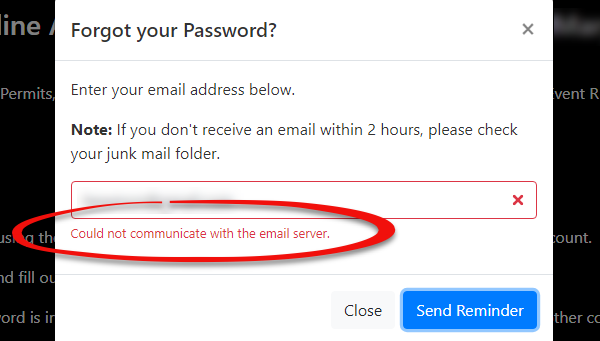
When a user attempts an action that triggers an automated email (such as using the forgot password form), the system relies on predefined sender addresses. If these addresses are missing, the system will fail to send the message, and the user will see a popup stating that the system could not communicate with the email server. This error explicitly indicates that the system lacks a defined "From" or "Reply-to" address.
Fixing Communication Errors
-
Hover over System Configuration and click System Settings.
-
Navigate to the General System Settings tab.
-
Locate the Reply-to Admin Email Address field.
-
Enter a valid, active email address into this field to serve as the system's sender address for automated communications.
-
Click Save to apply the configuration changes.
-
Re-attempt the user action that previously triggered the error (e.g., submitting the forgot password form) to verify the issue is resolved.
Communication errors are almost always symptomatic of missing or incorrectly configured email parameters. If a user reports an email delivery failure or a communication error popup, verifying your global email settings should always be your first troubleshooting step.
Best Practices and Considerations
-
Maintain crucial email fields: The Reply-to Admin Email Address and other sender settings found within the system settings are critical for all automated communications. Ensure these fields are always populated with valid, actively monitored email addresses to prevent widespread delivery failures.
-
Monitor system notifications: Regularly check the inbox of the email address configured as the Default Notification Email. Proactively monitoring this inbox helps administrators catch any internal system alerts regarding failed communications or server errors before end-users report them.
-
Escalate persistent issues: If the issue is still not resolved after configuring these fields, please contact support@ops-com.com for further assistance. When reaching out to support, be sure to provide specific details about the error message and the troubleshooting steps you have already completed.
Alarms System Settings
The Alarms System Settings feature allows administrators to configure and manage automated system alerts. Its primary purpose is to notify administrative and field enforcement staff of critical information regarding specific users, vehicles, or general events, thereby improving operational awareness and security. This article is intended for OPS-COM administrators responsible for backend configuration and enforcement operations.
Setup and Configuration
This feature is a core administrative tool used to define the active alerts that trigger within the system and on field enforcement devices.
Admin Side: Administrators must have the appropriate system role permissions enabled to access and configure these settings.
-
Hover over System Configuration and click Alarms System Settings.
-
Review the active alarm categories and select the specific type you wish to configure or manage.
-
Save any modifications to ensure they immediately propagate to the database and sync with active handheld devices.
Using this Feature
Administrators can use this feature to categorize and manage three distinct types of system alarms.
Available Alarm Types
-
People: Configure alarms that are tied directly to user profiles. This is commonly used to flag banned individuals, VIPs, or users with a history of severe parking infractions or unpaid violations.
-
Plate/Vehicle: Configure alarms that are tied directly to specific license plates or registered vehicles. This ensures that field enforcement officers are immediately alerted if they scan a scofflaw, a stolen vehicle, or a plate associated with a suspended permit.
-
Generic: Configure general alarms for broader system use that do not strictly tie to a single user profile or specific vehicle record.
Alarms configured in the backend sync directly to the handheld units used by enforcement staff. When an officer searches a flagged plate or user profile, the Android device will prominently display the alert on the screen so the officer can take immediate action.
Best Practices and Considerations
-
Standardize alarm descriptions: Ensure that all configured alarms include clear, concise instructions for responding staff. Field officers need to know exactly what action to take when an alarm triggers (e.g., "Do not approach, call dispatch immediately" versus "Issue a standard warning").
-
Prevent alert fatigue: Regularly review active alarms and remove those that are no longer applicable. Keeping hotlists and active alarm triggers clean ensures that enforcement officers take alerts seriously when they do appear, rather than habitually dismissing them.
-
Restrict configuration access: Organizations should strictly limit which administrators have the permission to create or modify system alarms. Tightly controlling this backend access prevents the system from becoming cluttered with unnecessary, duplicate, or poorly defined alerts.
Defining User Profile Settings
The User Profile Settings feature enables administrators to customize the specific information collected from users on their profile forms. Its primary purpose is to allow organizations to tailor the registration experience by controlling the visibility and mandatory status of data fields, ensuring that all necessary information is captured efficiently. This article is intended for OPS-COM administrators responsible for system configuration and user management.
Setup and Configuration
This feature is a core administrative tool used to dictate the fields presented to users during registration and profile updates.
Admin Side: Administrators must have the appropriate system role permissions enabled to access the global system settings menu and modify user profile requirements.
User Side: The configurations applied here directly dictate the fields end-users see and must complete when creating or updating their portal accounts.
Using this Feature
Administrators can use the following instructions to navigate to the settings menu and manage the visibility of various user profile fields.
Configuring Field States
-
Hover over System Configuration and click System Settings.
-
Click User Profile on the Manage System Settings screen.
-
Select the desired display state for each available profile item from the provided list.
Available Field States
The state selected for each field is highlighted in black, with a checkmark indicating the active selection. Items can be set to one of three states:
Customizing Profile Sections
The settings page allows you to customize several specific categories of user information:
-
User Name: A user name is an essential unique identifier for system access. While a bare minimum typically includes a username, first name, and last name, any of these items can be toggled based on your needs.
-
Address Information: This section is critical if your organization plans to mail physical permits or other correspondence to end-users.
-
Phone Information: Allows for the collection of various personal and primary phone numbers.
-
License Information: This field specifically refers to a driver's license number, not a vehicle license plate. You may opt to record this information if your organization is connected with local law enforcement.
-
Student Information: Controls fields relevant to student identification, such as student numbers and maximum/minimum digit limits.
-
Employee Information: Controls fields relevant to employee identification, such as staff numbers.
By default, the username field is not editable by administrators. If your organization requires the ability to manually change user account names, you must contact support@ops-com.com to request that the Allow Username Edits setting be enabled for your environment.
Text2ParkMe Configuration
If your organization utilizes the Text2ParkMe module, a second tab will be available on the User Profile settings page. This tab allows you to configure additional details that end-users can enter, including specific credit card information fields.
If any credit card information is entered by the user via the Text2ParkMe tab, the system automatically switches all other credit card information fields to a required state for that specific transaction to ensure payment processing succeeds.
Best Practices and Considerations
-
Balance data collection and the user experience: Avoid making too many fields required, as this can create friction and deter users from successfully completing their profiles. Prioritize truly essential information to streamline the registration process.
-
Understand underlying system overrides: Be aware that the system may still require certain fundamental pieces of information even if you attempt to hide them. For example, core identifiers like a username or email address are essential for basic functionality and may override your hidden settings.
-
Configure student address requirements: If you require students to provide both a mailing and local address, ensure you enable the Require Both Addresses for Students setting. Once filled out, admins can view both locations under the Active Addresses section of the user profile. Do not forget to also enable the Using Student Second Address setting so these fields are visible on the admin side.
-
Review hidden fields periodically: Ensure that fields marked as hidden truly remain irrelevant to your current processes. Organizational needs can change rapidly, making previously hidden data suddenly important for enforcement or reporting.
-
Tailor requirements to specific user types: Consider which information is truly necessary for different user classifications. You can configure the system to ask for different identifying details depending on whether the registering user is a student or an employee.
Account Creation Preferences
The Account Creation Preferences feature allows administrators to choose between granting users immediate portal access or requiring explicit email verification upon registration. Its primary purpose is to balance user convenience with system security and data integrity by controlling the onboarding flow. This article is intended for OPS-COM administrators responsible for managing the user registration experience.
Setup and Configuration
This feature is a global system setting that immediately dictates the onboarding workflow for all new users.
Admin Side: Administrators must have the appropriate system role permissions to access the configuration menus and modify the registration parameters.
User Side: Depending on the configured preference, new users will either be logged in immediately after creating an account or prompted to check their email for a verification link before they can access the portal. For complete user-side documentation, please refer to the Registering as a User with OPSCOM-Go! article.
Using this Feature
Administrators can use the following instructions to locate the registration setting and toggle the desired onboarding workflow.
Configuring the Account Creation Flow
-
Hover over System Configuration, click System Settings, and click the User Profile tab.
-
Locate the Auto Login After Register setting.
-
Enable the Auto Login After Register toggle to allow immediate login, or disable it to require email verification.
Available Configuration States
The Auto Login After Register setting has two distinct states, each with specific implications for user experience and system security:
-
Immediate Login (Enabled): This configuration allows users to instantly access their account immediately upon completing registration, bypassing email verification entirely. This method reduces friction and provides a quicker onboarding experience. It is ideal for scenarios where users might not have immediate access to their email, such as dedicated lobby kiosk setups.
-
Email Verification (Disabled): This configuration requires users to click a unique verification link sent to their registered email address before they can fully access their account. This is generally the preferred method, as it immediately confirms the registration originates from a real user with a valid email address, significantly reducing bot registrations and fake accounts.
While immediate login reduces friction, requiring email verification establishes a reliable communication channel from day one. This is crucial for securely processing future password resets, executing account recovery procedures, and delivering important system notifications.
Best Practices and Considerations
-
Balance security and convenience: Carefully weigh the trade-offs between user convenience (immediate login) and enhanced security (email verification) based on your organization's risk tolerance. Consider the technical literacy and typical access methods of your target audience when deciding on the preferred setting.
-
Ensure robust email deliverability: If you require email verification, verify that your system's global email sending configurations are properly established. This guarantees that verification emails are delivered promptly and reliably, preventing users from getting stuck during registration.
-
Communicate the registration process: Clearly inform users about the account creation process on your portal homepage. If email verification is required, provide explicit instructions reminding users to check their spam or junk folders for the activation link.
-
Maintain regulatory compliance: Consider that data privacy regulations often implicitly favor email verification. Forcing users to verify their email contributes to better data quality and acts as a verifiable record of user consent.
Configuring Multi-Factor Authentication on the User Portal
Multi-Factor Authentication (MFA) adds a crucial second layer of security to user accounts by requiring one-time passwords (OTPs) sent via email. Its primary purpose is to significantly enhance protection against unauthorized access to the system. This article is intended for OPS-COM administrators responsible for configuring global security settings and managing the user login experience.
Setup and Configuration
Implementing MFA involves administrator-side configuration within the system settings and customizing the associated email template.
Admin Side Configuration
One-time passwords will not be available on the user portal until enabled within the global settings.
-
Hover over System Configuration and click System Settings.
-
Navigate to the User Profile tab.
-
Configure the Enable Multi-Factor Authentication setting to your desired state.
If the MFA setting is not available for you to change, please have your primary administrator contact support@ops-com.com to have the feature enabled for your environment.
Email Template Configuration
The content of the one-time password email sent to users is defined within a dedicated email template.
-
Hover over System Configuration, click Content & Designs, then Email Templates.
-
Locate and click the One-Time Password Email Template to edit its contents.
-
Define the message and insert any relevant organizational branding.
-
Utilize the available shortcodes to insert the OTP details:
-
[one_time_password]: Inserts the randomly generated one-time password. -
[one_time_password value="issued_at"]: Inserts the time the password was generated. -
[one_time_password value="expires_at"]: Inserts the time the password expires.
-
Using this Feature
Administrators can use the ternary setting to flexibly control how MFA is implemented across the user portal, while users manage their individual settings from their profile.
Available Configuration States
The Enable Multi-Factor Authentication setting has three distinct states:
User Management
Users can enable and manage their one-time password settings directly from their security page. For detailed instructions on the user experience, please refer to the Multi-Factor Authentication - OPSCOM-Go! User Portal wiki article.
The state of a user's one-time password verification is stored in the local storage of their session data. If a user clears their browser cache, or attempts to log in using a different web browser or device, the MFA verification will not persist and they will be forced to enter a new one-time password.
Best Practices and Considerations
-
Execute a gradual rollout: When introducing MFA, consider starting with the Visible setting to allow users to opt-in voluntarily. Once your user base is accustomed to the feature, transition the setting to the Required state for all users if your organizational security policy mandates it.
-
Verify email deliverability: Ensure that your system's email settings are correctly configured and that OTP emails are not being blocked by institutional spam filters. Users must receive these emails promptly to successfully log in.
-
Communicate OTP expiry limits: Remind users that one-time passwords are time-sensitive and permanently expire after 15 minutes. Generating a new password will automatically invalidate any previous ones, and this system default cannot be changed.
-
Provide clear communication and training: Inform users about the MFA requirement, how to set it up, and how to log in using OTPs. Providing clear instructions and troubleshooting tips on your portal homepage reduces support tickets during the initial rollout.
Password and Security Settings
The Password and Security Settings feature provides administrators with critical tools to enforce robust password policies and manage login security for all backend administrative accounts. Its primary purpose is to protect sensitive system data, prevent unauthorized access, and ensure organizational compliance with modern security standards. This article is intended for OPSCOM administrators responsible for managing backend system configuration and access security.
Setup and Configuration
This feature requires high-level administrative access to view and manage global security protocols.
Admin Side: Administrators must have the appropriate system role permissions enabled to access the centralized system settings menu.
-
Hover over System Configuration and click System Settings.
-
Click Security to open the management window and view all available security configurations.
User Side: This feature dictates backend administrative security and does not directly configure the end-user parking portal login policies.
Using this Feature
Administrators can use the configuration window to define various aspects of password management, strength requirements, and automated account lockout policies.
Password Security Settings
-
Salted Password Hashing: Adds an essential layer of security by irreversibly converting passwords into unique, short hash values with a randomized "salt" string. This ensures that even if two users share the same password, their stored hash values remain completely different. It prevents reverse engineering, meaning forgotten passwords must be reset rather than retrieved.
-
Require Password Update: Forces administrators to change their passwords upon their next successful login. This is ideal for ensuring compliance after a manual password reset.
-
Toggle Password Expiry: Mandates regular password changes. When enabled, enter a numerical value into the Password Expiry in days field to define the exact lifecycle of an active password (e.g., 90 days).
-
Enable Password History: Remembers passwords previously used by an administrator to prevent immediate reuse. When enabled, set the How long to remember old passwords field (in days) to define the restriction duration.
Password Strength Requirements
These settings allow you to enforce complexity rules for all new administrator passwords:
-
Minimum Password Length: Sets the absolute minimum number of characters required for a valid password.
-
Enable password strength requirements: Toggles specific complexity rules on or off. When enabled, you can set a minimum required character count for Numerical Characters, Lower Case Characters, Upper Case Characters, and Non-Alpha Numeric characters (e.g., !, &, #).
Admin Account Lockout Settings
These settings provide an automated layer of security by locking an administrator out of their account after repeated incorrect password attempts:
-
Enable Admin Lockouts: Toggles the automated account lockout feature on or off.
-
Lockout after X Attempts: Sets the threshold for failed login attempts with an incorrect password before the system actively locks out the administrator.
-
Login attempt timeframe: Sets the timeframe (in minutes) during which incorrect login attempts are counted. For example, if an administrator fails 3 times within a 5-minute period, their account will be locked out.
-
Lock the admin out for X minutes: Sets the duration (in minutes) that the administrator's account will remain locked. For example, setting it to 120 minutes means the administrator is completely locked out for 2 hours before another login attempt is permitted.
Several major security settings (such as Salted Password Hashing, password expiry, and lockouts) are visible to administrators but can only be changed by the OPSCOM Team. For modifications to these restricted, read-only settings, please contact support@ops-com.com.
Best Practices and Considerations
-
Enable salted password hashing: Ensure Salted Password Hashing is permanently enabled for maximum password security. Once enabled, this setting should never be turned off, as doing so reopens a critical security vulnerability and allows administrators to view raw employee passwords.
-
Maintain a robust security policy: Always implement a comprehensive security policy that combines strong password requirements, mandatory expiry limits, and lockout mechanisms.
-
Enforce regular password expiry: Enforce regular password expiry intervals (e.g., every 90 days) to mitigate the risk of compromised credentials. Stale passwords are a primary vector for unauthorized access.
-
Configure meaningful lockout settings: Configure lockout settings to balance strict security with user convenience. Overly aggressive settings can lead to constant lockouts and administrative overhead, while lenient settings fail to prevent active brute-force attacks.
-
Communicate policies to staff: Inform administrators about the security policies in place, including password strength requirements and lockout procedures. Clear communication helps staff comply and understand exactly why they might be temporarily locked out of the system.
Uploading and Managing Files
The Manage Files feature provides a centralized repository for all files used across your application, primarily focusing on images for user and admin dashboards. Its primary purpose is to allow administrators to easily upload, view, organize, and manipulate visual content to ensure consistent branding throughout the system. This article is intended for OPS-COM administrators responsible for managing system content and visual assets.
Setup and Configuration
This feature is a core administrative tool used to store and manage system-wide assets.
Admin Side: Administrators must have the appropriate system role permissions enabled to access the configuration menus and modify system files.
User Side: This file manager is strictly a backend administrative tool; however, the uploaded files (such as logos, banners, and permit images) are ultimately visible to end-users on the parking portal.
Using this Feature
Administrators can use the following instructions to navigate the file manager, upload new assets, manipulate existing files, and embed images directly onto custom pages.
Accessing and Viewing Files
-
Hover over System Configuration and click Manage Files.
-
Select your preferred viewing layout from the interface:
-
Grid Mode: Displays a visual thumbnail preview of each image, which is highly useful for quickly identifying visual content.
-
Table Mode: Provides a detailed list view, displaying file names, sizes, and other relevant information.
-
Adding Files to the Repository
-
Click the Upload tool to open the file upload interface.
-
Click Select files and choose the desired images from your local device.
-
Click Submit to upload the files directly to your site's storage.
Once an image is successfully uploaded, it cannot be moved to a different folder. To maintain proper organization, ensure you navigate to and open the intended destination folder before you upload the image.
Managing Existing Files
-
Right-click on a specific image or file to open a contextual menu.
-
Click Download to save a copy of the file to your local device, Rename to change the file name, or Delete to permanently remove the file from the system.
-
Click View on an image, then click the Cropping icon to open a tool that allows you to resize or adjust the visible dimensions to focus on a specific area.
Adding Images to a Page
-
Click Insert in the text editor toolbar when editing a custom page or content area.
-
Select Image from the dropdown menu.
-
Click the search folder icon next to the source field to open the file manager.
-
Locate and double-click the specific image you wish to insert. The image will immediately be added to the page at the location of your cursor.
Best Practices and Considerations
-
Organize files using sub-folders: Consider creating sub-folders within the file manager to keep your assets organized and easy to locate. Because uploaded files cannot be moved once added, establishing a clean folder structure early prevents repository clutter.
-
Use descriptive file names: Always use clear and descriptive file names to simplify identification and referencing. For example, naming an asset company-logo-header.png is significantly better than a generic name like image1.png.
-
Optimize image sizes: Before uploading, optimize large images for web use. Smaller file sizes will drastically improve page load times for both the administrative backend and the end-user interfaces.
-
Backup critical assets: Consider maintaining local backups of critical branding assets as a best practice. While the system securely manages these files, having local copies of standard organizational logos and banners is always recommended.
-
Ensure path accuracy: When manually linking images to pages via HTML, ensure the URL path is exactly correct. File paths are often case-sensitive, so capitalization and spelling must perfectly match the uploaded file name.
Admin Dashboard Setup (Quick Start)
The OPSCOM Dashboard is a fully customizable, widget-based analytics interface built directly into the admin portal. Its primary purpose is to allow administrators to create tailored data views, arrange widgets freely on a drag-and-drop grid, and configure specific metrics to monitor daily operations. This article is intended for OPSCOM administrators seeking a brief overview of dashboard capabilities.
Setup and Configuration
Configuring personal dashboards and setting up widget layouts requires specific backend access.
Admin Side: Administrators must have the appropriate administrative permissions enabled within their user role to access, configure, and save dashboard layouts.
Using this Feature
Administrators can use the dashboard interface to construct personalized, real-time views of system data.
Customizing the Dashboard
Dashboard layouts and widget configuration are fully documented in our comprehensive feature guide. For detailed instructions on available widgets, deep customization, and advanced layout options, please refer to the Using the OPSCOM-ARC System Dashboard & Widgets article.
Best Practices and Considerations
-
Utilize automatic refreshing: Set your dashboards and widgets to automatically refresh on a configurable schedule. This ensures your analytics are consistently up-to-date without requiring you to manually reload the page.
-
Design for mobile responsiveness: Take advantage of the system's responsive design. Dashboards and widgets are fully responsive down to mobile widths, allowing you to easily monitor system metrics and enforcement operations from a smartphone or tablet.
-
Organize with multiple dashboards: Create multiple personal dashboards tailored to specific operational tasks. Instead of cluttering a single screen with too much information, separate your widgets logically (e.g., maintaining one dashboard for financial metrics and another for daily enforcement activities).