The Search Repeat Offenders report allows administrators to identify vehicles and users that have accumulated multiple parking violations. Its primary purpose is to help enforcement teams track chronic offenders, manage warnings, and apply appropriate penalties or towing actions. This article is intended for OPSCOM administrators.
## Setup and Configuration There is no specific system setup or configuration required to use this report. Access to the Search Repeat Offenders page is a standard administrative feature available to users with the appropriate violation management and reporting permissions enabled on their profile. ## Using this Feature Administrators can use this reporting tool to filter violation data and output specific counts based on either the vehicle or the user profile. [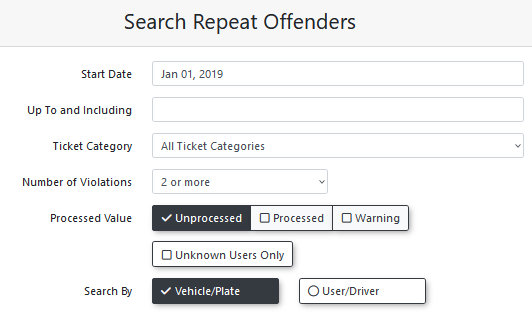](https://opscom.wiki/uploads/images/gallery/2026-07/mtmimage.png) 1. Hover over **Violations** and click **Search Repeat Offenders**. 2. Enter specific dates into the **Start Date** and **End Date** fields to specify the date range in which the violations were received. 3. Click the **Ticket Category** drop-down menu and choose a specific violation category to narrow the results. 4. Under **Search Criteria**, select either: - **Number of Violations:** Flags offenders based on ticket frequency. Choose a minimum threshold from the **Number of Violations** drop-down menu (e.g., 2 or more). - **Total Cost:** Flags offenders based on monetary value. Enter a minimum dollar threshold into the **Total Cost** field (e.g., $200). 5. Click the **Processed Value** check boxes and choose Unprocessed, Processed, or Warning to categorize violations based on their current status. 6. Enable the **Unknown Users Only** checkbox to exclusively show violations assigned to vehicles without a known user tied to them. 7. Click the **Search By** drop-down menu and choose **Vehicle/Plate** or **User/Driver** to determine how the output data will be grouped. 8. Click one of the green export buttons located at the top right of the search results to export the data in your chosen format. ### Key Information Displayed The data grouped in the output varies depending on whether you selected **Vehicle/Plate** or **User/Driver** in your search parameters. - **Vehicle/Plate Grouping:** Shows the number of violations on each specific license plate and lists any associated drivers of the vehicle. - **User/Driver Grouping:** Shows the total number of violations given to the user, including any violations assigned to vehicles where the user is the registered driver. - **Individual Violations:** In either grouping view, you can click on the hyperlinked violation count number to view the individual ticket details. ### Visual Cues and Status Indicators - **Warning Icon:** When searching by vehicle, a warning icon next to the username will show a targeted list of the violations associated specifically to that user. - **Breakdown Icon:** When searching by user, an icon next to the total violation count displays a breakdown of the total amount (showing the number of violations assigned directly to the user versus the number of violations assigned to that user's vehicles). --- ## Best Practices and Considerations - **Targeted Reporting:** **Utilize the Search By filter strategically based on your goals.** Searching by **Vehicle/Plate** is ideal for identifying unregistered cars or scofflaws that frequently violate lot rules, while searching by **User/Driver** is best for evaluating the overall compliance of a registered permit holder across all of their listed vehicles. - **Reviewing Warnings:** Use the **Warning Only** option under the **Processed Value** filter to evaluate if past warnings have been effective, or if a repeat offender has exhausted their leniency and now requires a fine-bearing ticket. - **Monetary vs. Count-Based Thresholds:** Use **Total Cost** when targeting high-balance accounts regardless of ticket count (ideal for identifying vehicles with large outstanding balances), and use **Number of Violations** to track repeat behavior patterns across multiple lower-cost infractions.